You Won’t Believe What I Found in Valparaíso’s Hidden Art Alleys
Valparaíso isn’t just a port city—it’s a living canvas. I went there expecting colorful houses and ocean views, but what I found blew my mind: street art that breathes, hidden galleries in old warehouses, and artists turning entire hillsides into open-air museums. This is more than graffiti—it’s rebellion, beauty, and soul poured onto walls. If you think art belongs only in museums, Valparaíso will change your mind. Let me take you through the most unexpected artistic journey of my life.
First Impressions: A City That Defies Expectations
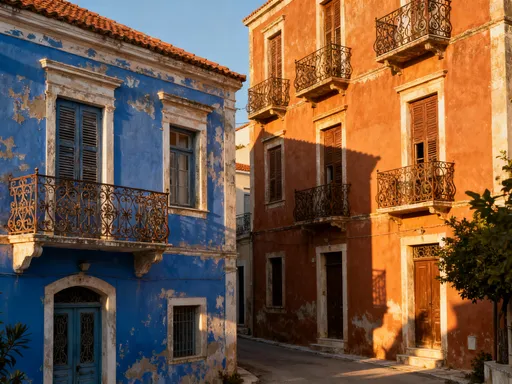
Arriving in Valparaíso feels like stepping into a dream that refuses to follow rules. The city spills down steep hills toward the Pacific, a tangle of narrow alleys, creaking funiculars, and houses painted in sun-faded blues, rust oranges, and mint greens. From the harbor, the scent of salt and diesel mingles with the faint aroma of grilled seafood from roadside stands. The noise is constant—seagulls cry overhead, vendors call out, and somewhere down a side street, a radio plays Latin jazz at full volume. It’s chaotic, yes, but not in a way that overwhelms. Instead, it pulses with a kind of rhythm, an organic energy that pulls you in.
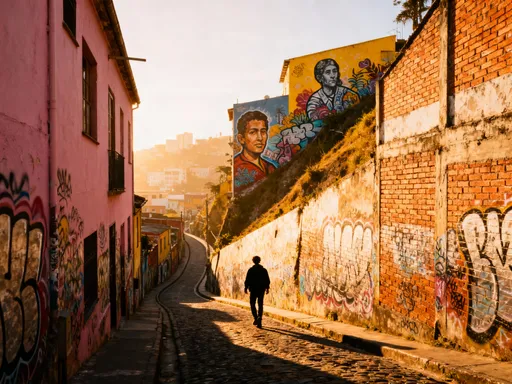
I had imagined a typical port town—functional, perhaps a little worn around the edges, with a modest waterfront promenade and maybe a few historic buildings. What I found was anything but ordinary. Valparaíso doesn’t just display art; it lives as art. Every surface seems to invite expression. A crumbling wall becomes a canvas for a giant mural of a woman with galaxies in her eyes. A staircase is tiled with mosaics spelling out poetry in broken ceramic. Even the electricity boxes on the sidewalk are painted with whimsical creatures and political slogans. There’s no separation between the city and its creativity—it’s all woven together, like threads in a constantly evolving tapestry.
What struck me most was how unapologetically raw it all felt. This wasn’t curated for tourists or sanitized for Instagram. It was messy, bold, sometimes unfinished—but always honest. The city doesn’t try to hide its cracks; it turns them into opportunities. Graffiti isn’t vandalism here—it’s dialogue. And as I began to wander deeper into the hills, I realized I wasn’t just visiting a place. I was entering a conversation.
The Heartbeat of the Hills: Art as Urban Identity
As I climbed the steep paths of Cerro Almirante and Cerro Concepción, I began to understand that Valparaíso’s art isn’t decorative—it’s foundational. Each neighborhood has its own voice, expressed through color, texture, and symbolism. Murals depict indigenous leaders, revolutionary poets, and everyday citizens with defiant expressions. One wall showed a child holding a key made of light, with the words "La memoria no se borra"—"Memory is not erased." Another portrayed a phoenix rising from a pile of broken bricks, a clear nod to the city’s resilience after years of economic decline and natural disasters.
This artistic explosion didn’t happen by accident. Valparaíso’s creative surge has deep roots in its history. Once a thriving port in the 19th century, the city declined when the Panama Canal opened, diverting international trade. Over the decades, it faced political upheaval, including the 1973 coup and the subsequent years of repression. In the absence of institutional support, art became a form of resistance—a way for people to reclaim their stories and their space. Without galleries or grants, artists took to the streets, turning blank walls into platforms for truth-telling and hope.
Today, that legacy continues. Walking through the hills, you don’t just see art—you feel its purpose. A stencil of a dancing couple might seem playful at first, but the accompanying date—1973—adds gravity, turning it into a tribute to lost freedoms. A mosaic of hands reaching upward, made from shattered plates and mirrors, speaks to collective healing. Even the funiculars, the old wooden elevators that climb the steepest slopes, are painted with murals that tell the history of the barrio. Art here isn’t separate from daily life; it’s embedded in it, like the roots of the bougainvillea that climb every available surface.
Beyond Murals: Unconventional Art Spaces You Can’t Google
While the murals are impossible to miss, the true magic of Valparaíso often lies in the spaces between them—places that don’t appear on maps or travel blogs. I stumbled upon one such spot after following the sound of a hammer tapping on metal. Behind a weathered wooden door in Cerro Bellavista, I found a courtyard filled with artists working at long tables. One woman was screen-printing fabric with botanical designs, another was welding scrap metal into delicate bird sculptures. A young man offered me a cup of herbal tea and explained that this was Taller Colectivo Amanecer, a community studio funded by small donations and volunteer work.
These spaces aren’t commercial galleries. There’s no reception desk, no price list, no expectation that you’ll buy anything. You’re simply welcome to watch, to ask questions, to sit and absorb the energy. I watched an elderly painter guide a teenager in mixing colors, their conversation shifting between technique and life advice. In another corner, a group rehearsed a puppet show based on local legends. The air smelled of turpentine, coffee, and damp earth from the potted plants lining the walls.
What makes these places so powerful is their authenticity. They exist because people need them—not for profit, but for expression and connection. Some are housed in abandoned homes, their floors creaking underfoot, their walls layered with decades of paint. Others occupy former laundries, bakeries, or storage units, repurposed with creativity and care. These aren’t tourist attractions; they’re lifelines. And while you won’t find them on Google, they’re easy to discover if you’re willing to wander slowly, knock on an open door, and say hello.
Walking the Creative Labyrinth: A Day in the Life of an Art Explorer
My most unforgettable day in Valparaíso began at Paseo Atkinson, a quiet walkway lined with colonial-era houses and ocean views. The morning light painted the water in shades of silver and blue. I sipped a warm empanada from a nearby vendor, watching fishermen mend their nets below. From there, I followed a narrow path uphill, guided more by curiosity than any plan. Maps helped, but I quickly learned that the best discoveries came from turning where the path felt interesting, not where the guidebook said to go.
Halfway up Cerro Bellavista, I passed a mural of a sleeping cat with stars in its fur. Beneath it, a small arrow pointed to a staircase labeled "Sube con cuidado"—"Climb with care." I did, and at the top, I found a tiny exhibition in what had once been a public laundry. The space was no bigger than a living room, but every wall was covered in small paintings—portraits of neighbors, abstract interpretations of storms, even a series on motherhood rendered in ink and gold leaf. A woman sitting in the corner smiled and handed me a printed card with the artist’s name and a QR code linking to a donation page. No entry fee, no pressure—just an invitation to witness.
By midday, I reached a sunlit plaza where a group of teenagers was spray-painting a new mural. The smell of fresh paint hung in the air, sharp and bright. One of them invited me to add a brushstroke, and though I hesitated, I dipped a small brush into cobalt blue and added a wave to the ocean they were creating. It was a tiny gesture, but it made me feel part of something larger. Later, I sat on a bench and ate a ripe mango from a street cart, juice dripping down my fingers, while listening to reggaeton drifting from an open window where a dance class was in session. The city didn’t just allow creativity—it celebrated it, in every form.
The People Behind the Paint: Conversations with Local Artists
Over several days, I had the privilege of speaking with a few of the artists who shape Valparaíso’s soul. One was Mateo, a muralist in his forties who began painting during the student protests of 2011. "Art was my way of speaking when words weren’t enough," he told me, wiping paint from his hands. His latest project, a 30-foot mural of a woman reading to children in a library made of books and bricks, was a tribute to public education. "We’re not just making pretty pictures," he said. "We’re building memory. We’re saying, This matters."
Then there was Lucía, a ceramicist who works with recycled materials. She showed me her studio, a converted garage filled with shelves of handmade tiles. "I use broken dishes, old sinks, even porcelain from toilets," she laughed. Her mosaics often depict native plants and birds, a quiet act of environmental advocacy. "People say Valparaíso is chaotic," she said, "but there’s so much beauty in the broken. We just have to see it."
Not all stories were triumphant. Several artists spoke openly about the pressures of gentrification. As Valparaíso gains international attention, property values rise, and long-time residents—especially artists—are being pushed out. "They love our art," one painter said, "but they don’t want us living here." Others mentioned the lack of consistent funding and the difficulty of balancing creative work with survival. Still, there was no bitterness—only determination. "We create because we must," Lucía said. "Even if no one sees it, even if it rains and washes away tomorrow. It’s who we are."
How to Experience Valparaíso’s Art Scene Like a True Explorer
If you’re planning to visit Valparaíso, come ready to move slowly and stay open. This isn’t a city to rush through. Wear sturdy shoes—the hills are steep, and the cobblestone paths can be slippery, especially after rain. Bring a camera, but don’t let it come between you and the moment. Some of the most powerful experiences happen when you put the lens down and just look.
Start your journey at the Museo a Cielo Abierto (Open Sky Museum) on Paseo Gervasoni. It’s one of the most accessible introductions to the city’s large-scale murals, including the famous "El Eco de los Andes" by Mario Toral. From there, let curiosity guide you. Take a funicular up one of the cerros—many still operate with their original wooden cars—and explore the streets above. Look for open doors, the sound of music, the scent of paint. These are your clues.
When you find a studio or gathering space, ask before taking photos. A simple "¿Puedo tomar una foto?" goes a long way. If artists are working, observe quietly. If they invite you in, accept with gratitude. And if you can, support them—buy a small print, a handmade tile, or a zine from a local collective. These purchases aren’t souvenirs; they’re gestures of solidarity.
Most importantly, resist the urge to treat Valparaíso like a checklist. Don’t measure your day by how many murals you’ve seen or how many photos you’ve taken. This city rewards presence, not productivity. Get lost. Sit on a bench. Talk to someone. Let the art find you, rather than chasing it. The deeper you go, the more you’ll realize: Valparaíso isn’t a destination. It’s an invitation to see the world differently.
Why This Matters: Art That Transforms Cities and Souls
Valparaíso taught me that art isn’t something you only admire from a distance. It can be a force that rebuilds communities, reclaims identity, and reimagines what’s possible. This city, once written off as faded and forgotten, has transformed itself not through grand development projects, but through the quiet, persistent act of creation. Every mural, every mosaic, every shared studio is a declaration: We are here. We matter. We create.
But the transformation isn’t just urban—it’s personal. Walking those hills, I felt something shift inside me. Watching artists turn brokenness into beauty, I began to see my own challenges differently. If a cracked wall can become a masterpiece, what might be possible in my own life? The courage to create, to speak, to rebuild—that’s contagious. Valparaíso doesn’t just display art; it offers a model for living with authenticity and resilience.
So let this be an invitation—not just to visit Valparaíso, but to seek out places like it. Look for destinations where culture isn’t performed for tourists, but lived every day. Where art isn’t confined to galleries, but pulses through the streets. Where people turn struggle into beauty, not for fame, but because they must. Travel to these places. Listen. Learn. Let them change you. Because the world needs more cities like Valparaíso—and more souls willing to create, even when no one is watching.